Cold calling remains one of the most direct and effective ways to generate leads, yet it's often met with dread and low success rates. The difference between a frustrating call and a successful meeting often comes down to strategy and execution, not just luck. This guide moves beyond generic advice to provide a deep dive into eight powerful cold calling best practices that elite sales professionals use to turn initial contact into valuable business relationships.
By mastering these specific techniques, you'll be equipped to not only increase your connection rates but also build the confidence needed to make every call count. We'll explore actionable frameworks and real-world examples to help you refine your approach and achieve consistent results in a competitive market.
This listicle breaks down everything from initial research and lead qualification using frameworks like BANT to advanced communication tactics such as the Bridge Statement and voice tonality control. We will also cover proven methods for persistence with the 7-Touch Rule and effective objection handling. These aren't just tips; they are foundational strategies for modern sales success, designed to be implemented immediately.
1. The BANT Qualification Framework
Effective cold calling isn't about calling everyone; it's about quickly identifying who is worth your time. The BANT qualification framework, originally developed by IBM, is one of the most enduring cold calling best practices because it provides a simple, powerful structure for qualifying prospects. BANT stands for Budget, Authority, Need, and Timeline, giving you four critical pillars to evaluate a lead's potential.
This methodology helps you stop wasting effort on dead-end conversations and focus only on prospects who have a genuine chance of becoming customers. By integrating BANT into your script, you can systematically gather the intelligence needed to prioritize your pipeline.
How to Implement BANT in Your Calls
Integrating BANT doesn't mean running through a checklist. It's about weaving questions naturally into the conversation to uncover key information.
- Budget: Determine if the prospect has the financial resources allocated for a solution like yours.
- Example Question: "To ensure I'm suggesting the right solution, what does a typical budget look like for a project of this scope?"
- Authority: Confirm you are speaking with the person who has the power to make a purchasing decision.
- Example Question: "Who, besides yourself, is typically involved in the decision-making process for new software tools?"
- Need: Uncover a specific pain point or challenge that your product can solve.
- Example Question: "What are the biggest challenges your team is currently facing with [prospect's area of responsibility]?"
- Timeline: Understand their urgency and when they plan to implement a solution.
- Example Question: "When are you hoping to have a solution in place to address this challenge?"
Key Insight: BANT is a guide, not a rigid script. A prospect might not have all four criteria perfectly aligned, but a "no" on three out of four is a strong signal to disqualify and move on. Document your findings in your CRM to ensure team visibility and effective follow-up.
2. The 7-Touch Rule for Persistence
In cold calling, giving up too early is the most common reason for failure. The 7-Touch Rule is one of the most vital cold calling best practices because it sets a realistic expectation for engagement. It posits that it typically takes at least seven meaningful interactions, or "touches," before a prospect is ready to have a serious sales conversation. This rule underscores that persistence, not pressure, is the key to breaking through the noise.
This multi-channel approach acknowledges that timing and repeated exposure are crucial. A single call might catch someone at the wrong moment, but a thoughtful sequence of communications builds familiarity and trust, significantly increasing your chances of getting a response. Platforms like Outreach.io have even built their entire sales engagement models around this multi-touch principle.
The infographic below visualizes key data that highlights the critical need for persistent follow-up in sales.
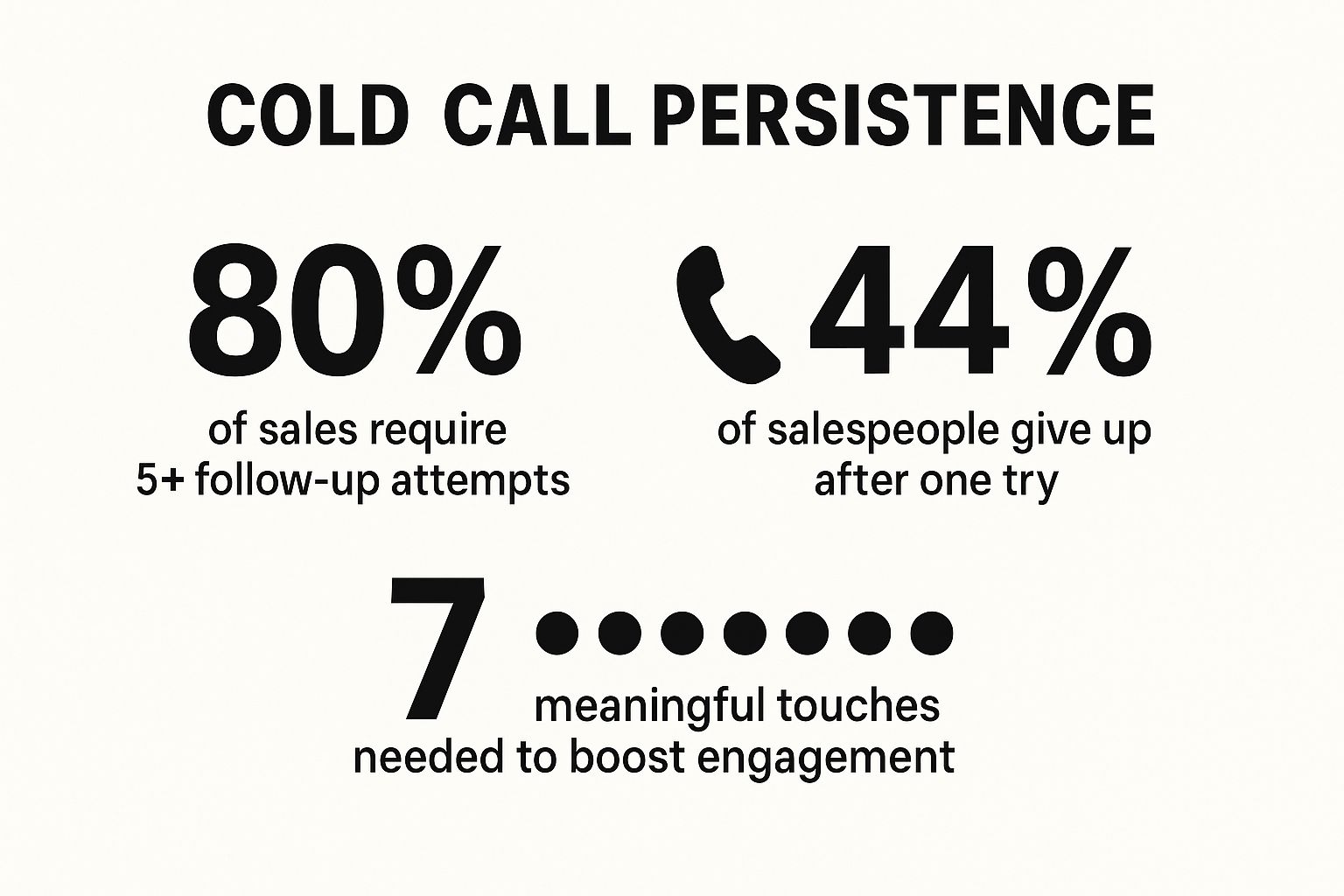
These statistics reveal a significant gap between the effort required to make a sale and the persistence shown by most salespeople.
How to Implement the 7-Touch Rule
Implementing this rule requires a strategic, multi-channel cadence, not just repeated phone calls. The goal is to provide value with each interaction.
- Vary Your Communication Channels: Don't rely solely on the phone. Mix in personalized emails, LinkedIn connection requests or messages, and even relevant content shares.
- Example Sequence: Call > Email > LinkedIn Message > Call with Voicemail > Email with a Case Study > Final Call.
- Provide Unique Value in Each Touchpoint: Every interaction should offer something new. Avoid messages that just say "checking in." Instead, share a relevant article, a quick tip, or a specific insight about their company.
- Example Value Add: "Following up on our brief chat, I saw your company just announced [X initiative] and thought this article on [relevant topic] might be useful for your team."
- Track and Schedule Touches in a CRM: Manually tracking seven touches per prospect is impossible at scale. Use your CRM to schedule tasks and automate reminders for each step in your cadence.
- Example CRM Task: "Task: Day 5 – Send LinkedIn Message to [Prospect Name] regarding [Pain Point A]."
- Personalize Messaging Based on Past Interactions: Reference previous conversations or messages to show you're paying attention and to create a continuous dialogue.
- Example Personalization: "When we spoke last Tuesday, you mentioned challenges with [specific issue]. Does this resource I found offer any clarity?"
Key Insight: The 7-Touch Rule is about strategic persistence, not annoyance. Each touchpoint must be executed with purpose and value. If a prospect explicitly asks you to stop contacting them, respect their wishes and remove them from your sequence immediately. The goal is to build relationships, not burn bridges.
3. Research-Driven Personalization
In an era where prospects are bombarded with generic outreach, personalization is no longer optional; it's essential. Research-driven personalization involves dedicating time to understand your prospect and their company before you pick up the phone. This approach transforms your call from a cold interruption into a relevant, timely conversation, making it one of the most effective cold calling best practices for cutting through the noise.
This strategy demonstrates genuine interest and positions you as a thoughtful advisor, not just another salesperson. By referencing specific details about their company, role, or recent achievements, you earn credibility and the right to ask for their time. This is a core tenet of modern sales prospecting; you can learn more about its impact in our guide to sales prospecting best practices on nordicleaddatabase.com.

How to Implement Personalization in Your Calls
Effective research doesn't mean spending hours on a single prospect. It's about efficiently gathering high-impact insights you can weave into your opening lines and value proposition.
- Company News: Look for recent funding rounds, product launches, or new executive hires.
- Example Opening: "Hi [Prospect Name], I saw your company just announced its expansion into the APAC region. Congratulations, that's a huge milestone. My name is [Your Name] from [Your Company]."
- LinkedIn Activity: Check their recent posts, comments, or shared articles. This reveals their professional interests and priorities.
- Example Opening: "I noticed your recent post on LinkedIn about the challenges of scaling your engineering team, which is a topic I follow closely…"
- Role-Specific Challenges: Research common pain points for their specific job title within their industry.
- Example Opening: "As the Head of Marketing, you're likely preparing for the holiday season push. I was calling because we help similar e-commerce leaders solve [specific problem]."
- Tech Stack: Use tools to identify technologies they currently use. This can reveal integration opportunities or competitive disadvantages.
- Example Opening: "I see your team is using [Competitor's Tool], and I wanted to share how we provide a more robust solution for [specific task]."
Key Insight: Aim for 3-5 minutes of focused research per high-value prospect. Use tools like LinkedIn Sales Navigator, company websites, and industry news outlets. The goal isn't to know everything but to find one compelling "hook" that makes your call immediately relevant and proves you've done your homework.
4. The Bridge Statement Technique
The first 15 seconds of a cold call are the most critical. You've interrupted someone's day, and their natural instinct is to hang up. The Bridge Statement is one of the most effective cold calling best practices because it smoothly transitions from your opening hook to your value proposition, acknowledging the interruption while quickly establishing relevance.
This technique builds a conversational "bridge" that justifies the call and earns you the right to continue. Instead of jarring the prospect by jumping straight into a pitch, you create a moment of connection that lowers their guard and keeps them on the line long enough to hear why you called.

How to Implement Bridge Statements in Your Calls
A great bridge statement is short, respectful, and focused on the prospect. Its goal is to pivot from "Who is this?" to "Why should I care?" in just a few seconds.
- Acknowledge the Interruption: Show you respect their time and are aware you're calling unexpectedly. This builds instant rapport.
- Example Statement: "I know I'm calling you out of the blue, and the reason for my call is…"
- Establish Immediate Relevance: Connect your call directly to their role, company, or a potential challenge you’ve researched.
- Example Statement: "I saw your company is expanding its remote team, and I was calling specifically because we help leaders like you manage distributed workforce productivity."
- Create a Dialogue: Use a bridge that invites a response rather than just talking at them. This turns a monologue into a conversation.
- Example Statement: "This may be unexpected, but I have a quick question about how you handle [specific business function]. Are you the right person to speak with about that?"
- Set a Clear Expectation: Let them know you will be brief, which reduces their anxiety about getting trapped in a long sales call.
- Example Statement: "I'll be brief. I'm calling because I noticed [trigger event], and I had an idea that might help you avoid [common problem]."
Key Insight: The best bridge statements sound natural, not scripted. Practice several variations so you can adapt your delivery based on the prospect's tone and energy. The goal isn't just to get through your script; it's to create a genuine, human connection that opens the door for a meaningful conversation.
5. Voice Tonality and Pace Control
How you say something on a cold call is often more important than what you say. Voice tonality and pace control is one of the most fundamental cold calling best practices because it directly influences how a prospect perceives you, your confidence, and your message. It's the art of deliberately managing your vocal delivery to build rapport, convey authority, and keep the listener engaged from the first second to the last.
This technique helps you move beyond your script to connect with prospects on a subconscious level. By modulating your tone, speed, and volume, you can project professionalism, match the prospect's energy, and guide the emotional flow of the conversation to achieve your desired outcome.
How to Implement Voice Control in Your Calls
Mastering your voice isn't about becoming a different person; it's about using your natural voice more strategically. Focus on weaving these vocal techniques into your conversations to sound more persuasive and credible.
- Slower Pace for Key Points: Deliberately slow down and lower your vocal tone when delivering your value proposition or a critical piece of information.
- Example Application: *"The main reason I'm calling is that we help sales leaders… like you… (pause)… reduce ramp time by an average of 40%."*
- Match Their Energy: Mirror the prospect's pace and energy level. If they are upbeat and fast-paced, match that enthusiasm. If they are more measured and calm, adjust your delivery accordingly.
- Example Application: For a high-energy prospect, you might say, "Absolutely! It sounds like you're managing a lot of moving parts, which is exactly where we come in!"
- Use Upward Inflection for Questions: End your questions with a slight upward inflection to naturally invite a response and sound more inquisitive than demanding.
- Example Application: "What are you currently using to manage your sales pipeline?" (with a rising tone at the end).
- Vary Your Pitch to Avoid Monotony: A monotone delivery signals boredom and disinterest. Vary your pitch and inflection throughout the call to keep the prospect engaged and interested.
- Example Application: Use a higher pitch to show excitement about a benefit and a lower pitch to convey seriousness when discussing a problem.
Key Insight: Your voice is your primary tool for building trust over the phone. Record your calls using tools like Gong.io or Chorus.ai to analyze your vocal patterns. Listen for moments where you sound rushed, uncertain, or monotonous, and practice smiling while you talk to naturally inject warmth into your tone.
6. The Permission-Based Approach
Cold calling often feels interruptive because, by its nature, it is. The permission-based approach is a powerful technique that mitigates this by transforming a monologue into a dialogue. It stands as one of the most effective cold calling best practices because it respects the prospect's time and autonomy, which immediately reduces their defensiveness and builds rapport.
This method involves explicitly asking for permission at key junctures of the call. Instead of launching directly into your pitch, you seek consent to proceed, which gives the prospect a sense of control and makes them more receptive to what you have to say. It shifts the dynamic from an unwelcome interruption to a collaborative conversation.
How to Implement a Permission-Based Approach
Weaving permission-based questions into your call creates micro-commitments that guide the prospect toward a deeper conversation. This strategy is most effective when used at transition points in the call.
- At the Opening: Secure permission to have the conversation in the first place.
- Example Question: "Hi [Prospect Name], this is [Your Name] from [Company]. I know I'm calling you out of the blue; do you have 30 seconds for me to explain why I called?"
- Before Probing: Ask for consent before you start asking discovery questions.
- Example Question: "To understand if we can even help, would it be okay if I asked you a couple of quick questions about your current [area of responsibility] process?"
- Before Pitching: Gain agreement before you present your solution's value.
- Example Question: "Based on what you've shared, it sounds like we might be able to help. Would it be helpful if I shared how we've assisted similar companies with [pain point]?"
- At the Close: Request permission to schedule the next step.
- Example Question: "Would you be open to scheduling a brief 15-minute call next week to explore this in more detail with our product specialist?"
Key Insight: A "yes" to a permission-based question is a small psychological agreement that makes the prospect more likely to agree to the next step. If you receive a "no," respect it. You can respond with, "I understand, when might be a better time to reconnect?" This maintains professionalism and keeps the door open for future interaction.
7. Objection Handling with the Feel-Felt-Found Method
Objections are an inevitable part of sales, but they don't have to be conversation-enders. The Feel-Felt-Found method is one of the most effective cold calling best practices for handling resistance because it validates the prospect's concern, builds rapport, and gently pivots the conversation toward a solution. It's a three-step framework for turning skepticism into curiosity.
This technique works by using empathy to disarm the prospect. Instead of arguing or immediately pushing back, you align with their perspective before introducing a new one. This reduces defensiveness and makes the prospect more receptive to hearing how your solution has successfully addressed similar concerns for others.
How to Implement Feel-Felt-Found in Your Calls
Mastering this method involves preparing concise, relatable responses for common objections you encounter. The key is to be genuine and use real-world examples whenever possible.
- Feel: Acknowledge and validate the prospect's feelings to show you are listening.
- Example for a "No Budget" Objection: "I completely understand how you feel about budget constraints right now; it's a major focus for everyone."
- Felt: Share that others have been in a similar situation. This normalizes their concern and builds a bridge of common experience.
- Example Continued: "Many of our most successful clients felt the exact same way when we first connected."
- Found: Introduce a new perspective or a successful outcome that offers a solution or re-frames the problem.
- Example Continued: "However, what they found was that by implementing our platform, they were able to reduce operational costs by 20% in the first quarter, which actually freed up more budget than they invested."
Key Insight: The power of Feel-Felt-Found lies in its structure: empathize, relate, and then re-frame. Build a library of these stories tailored to the top 3-5 objections you face. This preparation ensures you can respond confidently and effectively, transforming a potential rejection into a meaningful dialogue. After handling an objection, it's crucial to nurture that lead properly to maintain momentum. For more insights on this, you can explore detailed B2B lead nurturing strategies on nordicleaddatabase.com.
8. Strategic Call Timing and Scheduling
Calling a decision-maker when they are rushed, in a meeting, or away from their desk is a guaranteed way to fail. Strategic call timing is one of the most impactful cold calling best practices because it focuses on reaching prospects when they are most likely to be available and receptive. This involves moving beyond random dialing and instead analyzing industry, role, and time zone data to maximize your connection rate.
This approach transforms your calling schedule from a game of chance into a data-driven strategy. By understanding the typical workday rhythms of your target audience, you significantly increase the odds of having a meaningful conversation rather than just leaving another voicemail. It’s about working smarter, not just harder, to get your foot in the door.
How to Implement Strategic Timing in Your Calls
Integrating strategic timing requires research and testing. Start with general best practices and refine your approach based on the data you collect in your CRM.
- Target C-Suite Executives: These leaders often work outside of standard 9-to-5 hours. Try calling early in the morning (7-9 AM) or later in the afternoon (4-6 PM) to catch them before their day is filled with meetings or as they are wrapping up.
- Reach Mid-Level Managers: Their schedules are often packed with internal meetings mid-day. The best windows are typically mid-morning (10-11:30 AM) or just after lunch (2-4 PM).
- Connect with Small Business Owners: Owners wear many hats and may be unavailable during peak operational hours. Consider calling during their administrative blocks, often in the mid-morning or later in the evening.
- General B2B Best Practices: Studies consistently show that Tuesdays, Wednesdays, and Thursdays are the most effective days for B2B cold calls, as Mondays are for catching up and Fridays are for winding down.
Key Insight: Timing is not one-size-fits-all. Use these guidelines as a starting point, but diligently track your own connection rates by day and time in your CRM. Over time, your own data will reveal the optimal calling windows for your specific industry and target personas. Explore more advanced timing strategies when prospecting for leads to further refine your approach.
Cold Calling Best Practices Comparison
| Method/Technique | Implementation Complexity 🔄 | Resource Requirements ⚡ | Expected Outcomes 📊 | Ideal Use Cases 💡 | Key Advantages ⭐ |
|---|---|---|---|---|---|
| The BANT Qualification Framework | Low to Moderate 🔄 | Low – requires basic info gathering | Efficient lead prioritization, higher conversion rates 📊 | Early-stage lead qualification | Saves time, standardized criteria, improves forecasting ⭐ |
| The 7-Touch Rule for Persistence | Moderate to High 🔄 | High – multi-channel follow-ups | Increased connection and engagement rates 📊 | Persistent follow-up, prospects needing nurture | Builds trust, increases contact rates, professional persistence ⭐ |
| Research-Driven Personalization | High 🔄 | High – research tools, time per call | Higher connection and conversation rates 📊 | High-value or complex sales, personalized outreach | Builds credibility, meaningful conversations, reduces hang-ups ⭐ |
| The Bridge Statement Technique | Low 🔄 | Low – training and scripting | Lower immediate rejection, smoother call openings 📊 | Initial cold call engagement | Reduces rejection, natural flow, respect shown ⭐ |
| Voice Tonality and Pace Control | Moderate to High 🔄 | Moderate – training and practice | Better rapport, confidence conveyed 📊 | Calls requiring rapport and clarity | Builds rapport, reduces pressure, improves understanding ⭐ |
| The Permission-Based Approach | Low to Moderate 🔄 | Low – structured permission asking | Reduced resistance, increased engagement 📊 | Consultative or relationship selling | Respects autonomy, lowers hang-ups, collaborative flow ⭐ |
| Objection Handling with Feel-Felt-Found | Moderate 🔄 | Moderate – preparation of stories/examples | Reduced defensiveness, extended conversations 📊 | Managing sales objections | Empathy-driven, structured response, trust building ⭐ |
| Strategic Call Timing and Scheduling | Moderate 🔄 | Moderate – data analysis and testing | Higher connection rates, better call efficiency 📊 | Call planning and execution | Data-driven scheduling, reduces gatekeeping, optimized dialing ⭐ |
Bringing It All Together for Your Next Call
Mastering the art and science of cold calling isn't about finding a single magic script; it's about building a robust, adaptable system. Throughout this guide, we've deconstructed eight of the most impactful cold calling best practices, moving from foundational frameworks to nuanced execution techniques. These strategies are not isolated tricks but interconnected components of a successful outreach engine.
Think of these practices as a layered toolkit. The BANT framework provides the strategic filter to ensure you're even calling the right type of prospect. Research-driven personalization and the Bridge Statement technique work together to create an opening that feels relevant and respectful, earning you the right to continue the conversation. Meanwhile, your voice tonality and pace control are the delivery mechanisms that build subconscious trust and rapport.
From Theory to Actionable Strategy
It can feel overwhelming to try and implement all these strategies at once. The key to progress is incremental integration, not a complete overhaul. True mastery comes from transforming these conscious actions into subconscious habits.
Focus on a phased approach:
- This Week: Concentrate on just two areas. For example, dedicate your efforts to perfecting your research-driven personalization before each call and using the Permission-Based Approach in your opening. Track how this simple change affects your connection rates and initial reception.
- Next Week: Once you're comfortable, integrate a third element, like the Feel-Felt-Found method for handling objections. Practice it with a colleague until it feels natural and authentic.
- Ongoing Refinement: Continuously layer in other practices like strategic call timing and a structured 7-touch persistence sequence. The goal is to build a cohesive workflow where each element supports the others, creating a seamless and effective calling process.
The True Value of a Refined Approach
Adopting these cold calling best practices does more than just improve your immediate results. It fundamentally changes the nature of your interactions. You shift from being an interruption to becoming a welcome and valuable resource. Your calls become strategic consultations, not just sales pitches. This builds a stronger pipeline, shortens sales cycles, and ultimately establishes you as a trusted authority in your industry.
The confidence that comes from knowing you have a proven plan for every stage of the call-from the first three seconds to navigating tough objections-is a powerful asset. By committing to this process of continuous improvement, you transform cold calling from a daunting task into a predictable, scalable, and even enjoyable driver of business growth. Your next dial doesn't have to be a shot in the dark; it can be a calculated step toward your next big win.
Ready to supercharge your research and connect with the right decision-makers instantly? The most effective techniques rely on accurate data. Nordic Lead Database provides the verified contact information you need to stop wasting time on dead ends and focus on executing these proven cold calling best practices. Explore our database today at Nordic Lead Database and start your next call with confidence.